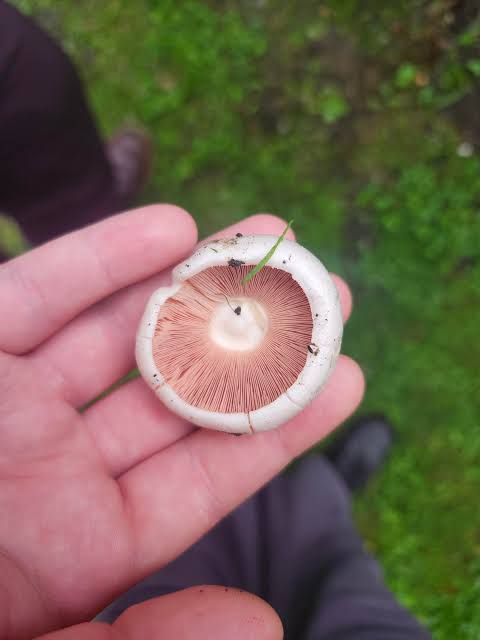

Mushrooms with pink gills occur in several unrelated groups. Young Agaricus mushrooms may have pink gills that become chocolate brown as spores mature. Many Entoloma species develop pink spores, and some Pluteus species have free gills that turn pink. These groups do not share one edibility status.
Gill color is a useful observation, not a final identification. Lighting, age, bruising, spore deposits, and camera settings can change how the color appears. Always examine the entire mushroom, including its stem base and habitat.
| Possible group | Gill attachment | Spore-print tendency | Typical habitat clue | Major caution |
|---|---|---|---|---|
| Agaricus | Free from stem | Brown to chocolate brown | Soil, grass, compost-rich ground | Includes edible and problematic species |
| Entoloma | Attached in several patterns | Pink | Soil, woods, grasslands | Many are difficult or unsafe |
| Pluteus | Free from stem | Pink | Decaying wood | Species identification still required |
| Volvopluteus/Volvariella relatives | Free from stem | Pink | Soil, plant debris, wood-related substrate | Stem base and volva are critical |
| Young white-spored mushroom | May only look pink from reflected color | White or pale | Many habitats | A true spore print can correct the impression |
Why mushrooms with pink gills change color
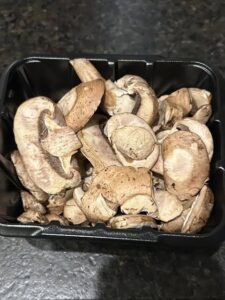
Gill tissue has its own color, but maturing spores can coat the surface. A young white button mushroom often shows pale pink gills. As Agaricus bisporus matures, the gills become dark brown because its spores are brown.
In a pink-spored group, mature spores may give the gills a salmon or rose cast. Very young specimens may not yet show that color. Rain can wash surfaces, while age can darken or discolor them.
Make observations in natural light. A phone flash can turn beige gills pink or wash out subtle tones.
Start with gill attachment
Remove or cut one specimen vertically through the center to see how the gills meet the stem.
- Free gills stop before reaching the stem, leaving a narrow gap.
- Attached gills meet the stem directly.
- Notched gills dip near the attachment.
- Decurrent gills run down the stem.
Free pink gills can point toward Pluteus on wood or a volva-bearing relative on other substrates, but more features are still required. Free young pink gills that later become brown are consistent with Agaricus.
Make a spore print
Place a mature cap gill-side down across white and dark paper. Cover it with a bowl to reduce air movement and leave it for several hours.
The print shows the color of spores in mass, which may differ from the visible gill tissue. Chocolate-brown spores support Agaricus, while pink spores can support groups such as Entoloma or Pluteus. White spores may reveal that pink-looking gills were an optical or tissue effect.
A print narrows possibilities but does not prove species or edibility.
Examine the stem base of mushrooms with pink gills
Collect the full base instead of cutting the mushroom at ground level. Look for:
- A cup or sack-like volva
- A swollen bulb
- A ring or skirt on the stem
- Cobweb-like veil remains
- Rooting extension
- Colored bruising
- Attached wood or plant material
A volva can be buried. Dig around the base carefully so it is not left in the soil. This is particularly important because several dangerous white-gilled Amanita species have a volva and ring, and poor lighting can produce misleading color impressions.
Common group: Agaricus
The cultivated button mushroom is Agaricus bisporus, but wild Agaricus identification is more complicated. Typical genus-level features include free gills, a brown spore print, and often a ring. Odor, staining reactions, habitat, and cap structure help separate species.
Some wild Agaricus species are edible, while others cause illness. A supermarket button is not a visual safety template for every lawn mushroom with pink gills.
Common group: Entoloma
The Entoloma group is associated with pink spores and angular spores under a microscope. Species can grow in forests, grasslands, moss, and disturbed ground. Many are difficult to separate without technical study.
Because the group contains species that should not be eaten, a pink spore print plus attached gills is not a shortcut to a meal.
Common group: Pluteus
Many Pluteus species grow on decaying wood and have free gills that turn pink as spores mature. The stem usually lacks a true ring and volva, though complete examination is necessary.
Buried wood can make a mushroom appear terrestrial. Check beneath leaf litter and note whether the stem is connected to a log, stump, wood chip, or root.
Record the habitat
Habitat can eliminate unlikely options. Photograph the mushroom before collection and record whether it grows:
- From a lawn or pasture
- On visible wood
- From buried wood or wood chips
- In leaf litter under hardwoods or conifers
- In compost or a garden bed
- Singly, scattered, or in a cluster
Also record geography, season, recent rain, nearby trees, and odor. Identification improves when details are collected at the site instead of reconstructed later.
Do not use unreliable tests
Silver-spoon tests, onion color changes, insect damage, animal feeding, taste, and easy cap peeling do not prove a mushroom is safe. Cooking does not neutralize every toxin.
Photo-recognition apps are best treated as brainstorming tools. They often cannot see the stem base, spore color, microscopic features, or local species distribution.
What to do with unknown mushrooms with pink gills
Keep it separate from food. Photograph it, make a spore print, and place it in a paper container with location and habitat notes. Contact a regional mycological club, university diagnostic service, extension resource, or experienced identifier.
If a child or pet may have eaten an unknown mushroom, do not wait for a casual online response. Retain the specimen and contact an appropriate urgent professional service.
A comparison process that avoids confirmation bias
Write the features down before choosing a name. Start with gill attachment and spore print, then describe the ring, base, odor, bruising, and substrate. Only after that should you open a field guide.
Compare the specimen against the complete description, not just the matching features. A useful identification explains why alternatives do not fit. For example, free gills plus a pink print and confirmed wood substrate may support Pluteus, but the absence of a volva and other genus features still need attention.
If the mushroom is too young to produce a print or too old to show its original structure, leave it unidentified. Uncertainty is a valid result.
Why store-bought buttons are different
Cultivated Agaricus bisporus comes through a known food-production system and carries a product label. A similar lawn mushroom has no such identity. Do not transfer confidence from a grocery mushroom to a wild specimen based on pink gills and a white cap.
Frequently asked questions
No. Edible, inedible, and harmful species can have pink-looking gills or pink spores.
The gills darken as brown spores mature. This is normal for Agaricus bisporus.
Gill tissue can look pink even when spores are another color. A print shows spores collected in mass.
Typical Amanita gills and spores are white or pale, but lighting and age can mislead. Always inspect the full stem base, ring, and spore print.
Usually not. Attachment, spore print, stem base, substrate, and regional features are essential.