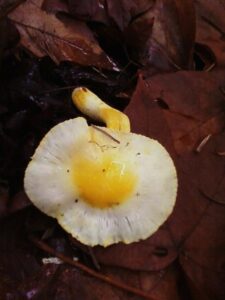
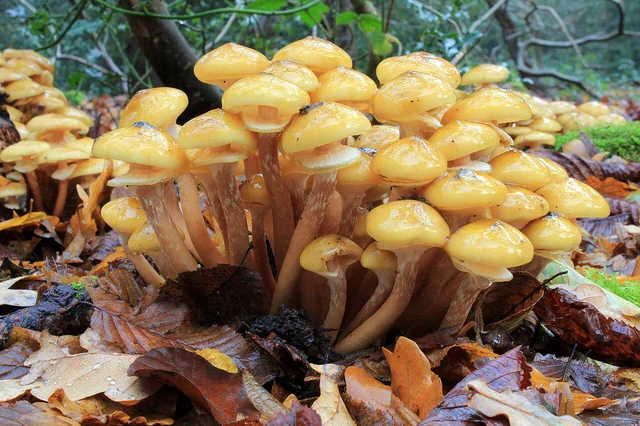

The most dangerous honey mushroom look alike is the deadly Galerina group, which can grow on wood in the same season and even near honey mushrooms. Other confusing groups include jack-o’-lanterns, Pholiota, Gymnopilus, sulfur tufts, and several unrelated tan clustered mushrooms.
“Honey mushroom” itself refers to multiple Armillaria species, including ringed and ringless forms. Identification requires more than cap color and clustered growth. Spore print, gill attachment, stem structure, ring, growth substrate, and regional species all matter.
Honey mushroom look alike comparison table
| Group | Spore print | Typical growth | Important feature |
|---|---|---|---|
| Armillaria honey mushrooms | White | Clusters from roots, stumps, or wood | Fibrous stem; ring present in some species |
| Deadly Galerina | Rusty to brown | On decaying wood, sometimes clustered | Brown spores; ring may be present or fade |
| Jack-o’-lantern | Pale cream to yellowish | Dense orange clusters from wood or buried roots | True decurrent gills; orange flesh |
| Gymnopilus | Rusty orange-brown | Clusters or groups on wood | Orange-brown spores and often bitter flesh |
| Pholiota | Brown | Scaly clusters on wood | Scaly caps or stems in many species |
| Sulfur tuft relatives | Purple-brown to dark | Dense clusters on logs and stumps | Yellow-green tones; group is difficult |
This is a screening chart, not an eating guide.
What to check before judging a honey mushroom look alike
Honey mushrooms often have tan, yellow-brown, or honey-colored caps with darker scales near the center. They grow from wood, roots, buried roots, or the base of trees. Gills are pale when young and may become spotted with age.
Many species grow in dense clusters with stems fused near the base. Ringed species have a skirt-like annulus, while ringless honey mushrooms lack one. The stem is usually fibrous rather than brittle.
A white spore print is a key genus-level clue. It becomes especially important because several look-alikes develop brown or rusty spores.
Deadly Galerina as a honey mushroom look alike
Galerina marginata and related naming concepts are small to medium brown mushrooms associated with decaying wood. They can have a ring, brownish cap, and clustered growth, which creates dangerous overlap with honey mushrooms and wild enoki.
The spore print is rusty brown rather than white. Mature gills become brownish as spores accumulate. However, Cornell guidance warns that young gills may still look pale and that a ring can degrade with age.
Never sort a mixed wood-growing cluster by casually removing “odd” caps. Different species can fruit inches apart or intermingle. Every individual intended for food needs verification.
Jack-o’-lantern mushrooms
Jack-o’-lanterns are orange mushrooms in the genus Omphalotus. They often form dense clusters from stumps, roots, or buried wood. Their sharp true gills run down the stem.
They are more commonly confused with chanterelles, but a forager focused only on honey-colored clusters may also misread them. Do not depend on reported glow; bioluminescence can be faint and is not a field requirement.
Gymnopilus species
Many Gymnopilus mushrooms are orange, yellow-brown, or rusty and grow on wood. Their spore print is rusty orange-brown. Some have rings or veil remnants, and large forms can superficially resemble robust honey mushrooms.
Taste is sometimes described as bitter in technical keys, but tasting an unknown mushroom is not a beginner identification step. Use structure, spore color, microscopy when needed, and expert confirmation.
Pholiota and scaly wood mushrooms
Pholiota species often grow in clusters on wood and may have sticky or scaly caps. Brown spores can dust the gills or lower stems. Rings, scales, and color vary with age and weather.
The presence of cap scales does not prove Armillaria, because several wood-growing groups are scaly. Photograph both fresh young caps and mature specimens.
Sulfur tufts and similar clusters
Small yellow mushrooms in tight clusters on logs often belong to Hypholoma or related-looking groups. Some develop greenish-yellow gills, while mature spores darken the underside.
These are not honey mushrooms simply because they grow from the same stump. A single log can host multiple fungi over one season.
How to make a proper spore print
Select a mature cap and place it gill-side down across white and dark paper. Cover it with a bowl and wait several hours. Keep the print with the labeled specimen.
Honey mushrooms produce a white print. Brown, rusty, or dark spores point elsewhere. A white print supports Armillaria but does not establish the exact species or edibility.
Inspect the entire stem
Dig or cut carefully enough to retain the base. Note:
- Whether multiple stems fuse together
- Presence, position, and texture of a ring
- Fibrous versus brittle flesh
- Color above and below the ring
- Scales, fibers, or darkening
- Connection to visible or buried wood
- Black root-like rhizomorphs near infected wood
Rhizomorphs and white fungal fans under bark can support an Armillaria tree-disease diagnosis, but fruiting-body identification still requires all features.
Honey mushrooms and tree health
Armillaria can cause root rot. UC IPM notes that clusters may arise from buried roots away from a current tree or around an old stump. A fruiting cluster can therefore be both an identification question and a landscape-health clue.
If mushrooms appear at the base of a large living tree, document the location and contact a qualified arborist when the tree could strike people or property. Removing the caps does not remove fungus inside roots or wood.
Why common edibility advice is not enough
Some honey mushrooms are eaten after thorough cooking, but people report gastrointestinal reactions, and local species differ. The University of Minnesota tree-disease resource notes that honey mushrooms contain compounds that make some people sick.
Even a correctly identified group requires species-level local guidance, sound condition, thorough cooking, and a small first portion. Alcohol-related warnings and preparation traditions appear in some regional sources, so consult an expert familiar with the specific species.
A specimen-by-specimen sorting method
Place each mushroom on a clean surface in the exact subgroup in which it was collected. Compare cap scales, gill color, ring, stem texture, and base. Do not assume that every cap from one stump belongs to the same species.
Make separate spore prints from representative mature caps. A rusty print from even one subgroup is a serious warning that the collection is mixed or not Armillaria. Keep prints and photographs with the specimens until identification is complete.
Young and mature mushrooms can look different, so a useful collection includes several stages. However, old waterlogged mushrooms may have lost critical features and should be left unidentified rather than forced into a name.
When to walk away
Do not use the collection when the stem bases are missing, the mushrooms are too old for a reliable print, the habitat notes were not recorded, or an expert cannot rule out Galerina. Abundance does not reduce risk; a large cluster can still be misidentified.
Frequently asked questions
Deadly Galerina is the major concern because it grows on wood and may have a ring. Its spore print is rusty brown rather than white.
No. Ringless honey mushrooms exist, so the absence of a ring does not rule out the group.
They often cluster, but growth pattern varies. Clustering alone never confirms the identification.
Yes, separate species can fruit on the same wood or very close together. Check every specimen.
No. It is one identification clue and many unrelated mushrooms also have white spores.