
The name egg mushroom can mean different things. Some culinary references use it for the golden chanterelle, historically labeled Cantharellus cibarius. In other regions, people use “egg” for an immature Amanita or stinkhorn enclosed in a rounded universal veil. Those are not interchangeable mushrooms.
Because the name can point to an edible chanterelle or to the young stage of a genus containing deadly species, never make an eating decision from “egg mushroom” alone. A complete scientific identification and geographic context are necessary.
Meanings at a glance
| Use of the name | What it may describe | Key caution |
|---|---|---|
| Culinary “egg mushroom” | Golden or yellow chanterelle | Chanterelle names cover multiple species |
| Egg-stage mushroom | A young fruiting body inside a veil | Could include dangerous Amanita species |
| Stinkhorn egg | Immature stinkhorn in a gelatinous layer | Different structure and life cycle |
| Regional market name | A local edible species | Name may not transfer to another region |
| “Egg yolk mushroom” | Bright yellow-orange mushroom | Color nickname is not an identification |
Egg mushroom as a chanterelle name
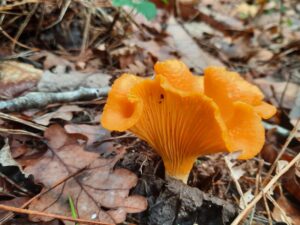
Several food references list “egg mushroom” among the common names for the golden chanterelle. The term likely reflects its rich yellow color. Other names include girolle and pfifferling.
Chanterelles have a vase- or funnel-like form and blunt folds or false gills that run down the stem. The flesh is generally solid, and they grow from soil in association with living trees rather than in dense bouquets directly from a stump.
Modern taxonomy recognizes multiple chanterelle species in North America. A European name applied broadly in an old cookbook may not be the correct species name for a U.S. collection.
Chanterelle versus jack-o’-lantern
Jack-o’-lantern mushrooms are a major orange look-alike. They have sharp true gills and often grow in clusters from wood or buried roots. Chanterelles usually have blunt ridges and grow separately or in loose groups from soil.
Do not rely on the reported glow of jack-o’-lanterns; it may be faint. Structure and substrate are more dependable screening features, followed by local expert confirmation.
The Amanita egg stage
Young Amanita mushrooms can begin inside a rounded universal veil that resembles a white egg. As the mushroom expands, the veil breaks and may leave a cup or patches at the stem base and material on the cap.
The genus includes prized edible species and deadly species such as death caps and destroying angels. A closed “egg” hides the cap, gills, ring, and stem, which makes it especially difficult for beginners to identify.
Cutting an egg vertically can reveal a developing cap and stem inside. A true puffball is generally uniform inside when young, whereas an Amanita egg shows the outline of a mushroom. This comparison is an educational clue, not permission to eat the specimen.
Caesar’s mushroom and North American relatives
The European Caesar’s mushroom, Amanita caesarea, has an orange cap, yellow gills and stem, a ring, and a white sac-like volva. North America has related species and groups, including Amanita jacksonii in the East.
These mushrooms are sometimes connected to “egg” names because they emerge from a volva and are eaten in some traditions. However, confusing an edible Caesar group with another Amanita can be fatal. This is expert-level identification.
Stinkhorn eggs
Stinkhorns also begin as rounded or oval “eggs” in soil, mulch, and wood-rich garden beds. Cutting one open often reveals a gelatinous layer and the developing stinkhorn structure.
Mature stinkhorns grow rapidly and produce strong-smelling spore slime that attracts flies. They are not chanterelles and should not be placed into the same culinary category.
Puffballs and false confidence
Young puffballs can be round, but they lack a normal cap-and-stem structure inside. A vertical cut through the center should show uniform white flesh in species considered at an edible stage.
An immature gilled mushroom enclosed by a veil can mimic a puffball from outside. Because a deadly Amanita can be hidden within, beginners should not use shape alone.
How to identify what a writer means
When this ambiguous name appears in a recipe, catalog, or web article, look for:
- Scientific name
- Photograph of the mature mushroom
- Country and region
- Description of gills, ridges, pores, or internal structure
- Habitat and host trees
- Whether it is a market product or wild collection
- Source date and taxonomic authority
If the scientific name is missing, treat the common name as incomplete.
Buying mushrooms sold under this name
At a specialty market, ask the seller for the exact species and whether the mushrooms are cultivated or professionally foraged. A label saying “chanterelle” is more useful when it also includes origin and species or supplier information.
Choose firm, dry mushrooms without slime, mold, or strong decay odor. Keep the package cold and use delicate chanterelles promptly.
Cooking confirmed chanterelles
Brush debris from the ridges and trim dirty bases. Use a quick rinse only when needed, then dry thoroughly.
Cook in a wide skillet until released water evaporates. Add butter or oil, shallot, thyme, salt, and pepper. Chanterelles pair well with eggs, cream, pasta, toast, potatoes, and chicken.
Do not apply this cooking guidance to an unknown egg-stage mushroom. Cooking does not make a misidentified Amanita safe.
How restaurants and markets use the name
A European menu may use a translated common name for chanterelles, while a produce seller may prefer “golden chanterelle” or “girolle.” In another cultural context, the same English words may describe a completely different local mushroom.
Before publishing a recipe or product page, pair the common name with the supplier’s scientific name and country of origin. Do not add Cantharellus cibarius automatically when the supplier only says “chanterelle,” because North American products may belong to another species.
Writing accurate SEO content about ambiguous mushroom names
Answer the ambiguity in the introduction rather than presenting one meaning as universal. Explain culinary chanterelles, immature Amanita, puffball confusion, and stinkhorn eggs in separate sections.
Use images only when their species and license are known. A stock photograph using this common name may show a Caesar-group Amanita, a chanterelle, or a sliced puffball. Incorrect imagery can turn an educational article into unsafe identification advice.
What to do after finding an egg-shaped fungus
Photograph it in place and record soil, mulch, wood, nearby trees, and geographic region. When collection is legal, lift the whole specimen without breaking the outer structure. Cut one vertically for documentation, keep it separate, and consult a local expert.
Do not carry a closed egg into the kitchen with edible mushrooms. The hidden mature structures are exactly why this stage deserves extra caution.
Frequently asked questions
Sometimes. Some English culinary sources use it for golden chanterelles, but the name is not universal.
The genus includes deadly species, and the closed stage hides critical features. Do not eat an unknown Amanita egg.
A vertical section through an Amanita egg reveals a developing cap and stem. A young true puffball is uniform inside, but expert confirmation is still necessary.
No. They are immature stinkhorn fruiting bodies with a different structure.
No. Recipes assume an ingredient has already been correctly sourced and identified.