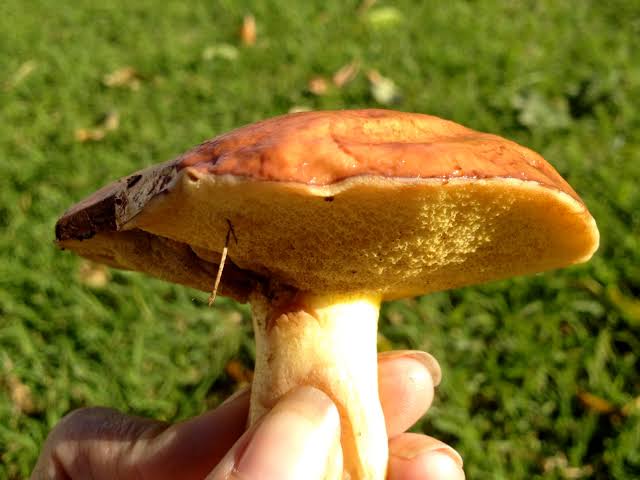

The classic slippery jack mushroom is Suillus luteus, a bolete with a sticky brown cap, yellow pores instead of gills, a pale stem with glandular dots, and a ring left by a partial veil. It forms mycorrhizal relationships with pine and often appears from late summer into fall after rain.
“Slippery jack” is also used loosely for several Suillus species. Correct identification matters because features, food quality, and individual reactions vary.
Slippery jack mushroom identification summary
| Feature | Typical Suillus luteus clue |
|---|---|
| Cap | Brown to reddish brown, smooth and very sticky when wet |
| Underside | Yellow tube layer with pores, no gills |
| Stem | Pale to yellowish with small glandular dots |
| Ring | Present, often pale above and darker below with age |
| Flesh | White to pale yellow, generally not strongly blue-staining |
| Habitat | On soil in association with pine |
| Season | Late summer through fall |
| Spore print | Brown to olive-brown |
Why it is called slippery jack
The cap develops a thick, sticky or slimy coating in wet weather. Pine needles and debris often cling to it. During dry weather the cap can look shiny rather than obviously slimy, so texture should be checked with other features.
The sticky skin is commonly peeled before cooking. Many guides also remove the soft pore layer from older specimens.
Pores instead of gills
Turn the cap over. A slippery jack has a sponge-like layer of tiny tubes ending in pores. Young pores are yellow and can become darker or more olive with age.
This immediately separates it from gilled mushrooms, but it does not identify the exact bolete. Many Suillus and other boletes share pores and pine habitat.
The ring and partial veil
Young S. luteus has a veil covering the pore surface. As the cap expands, that tissue breaks and leaves a ring around the stem. The ring may collapse, stain, or become less distinct in old specimens.
Other slippery jacks lack a prominent ring. Therefore, the common name should not be applied to every sticky bolete without checking a regional key.
Pine association
Slippery jacks grow with pine roots rather than directly from dead wood. They can appear beneath planted pines in parks, campuses, lawns, and forests. The exact pine association helps narrow the species.
The Natural History Museum of Utah notes that Suillus species have spread widely where people introduced pine trees. A mushroom beside a pine may still belong to another group, so host alone is not proof.
Similar Suillus species
American slippery jack
Suillus americanus is associated with eastern white pine and has a yellow cap with reddish-brown markings. It does not match the dark brown ringed look of classic S. luteus.
Granulated slippery jack
Suillus granulatus and related concepts have glandular dots but no persistent ring. Taxonomy and regional species boundaries can be complicated.
Short-stemmed slippery jack
Suillus brevipes often has a shorter stem and lacks the classic ring. It grows with pine in western North America.
These examples show why “slippery jack” is a group-level culinary label in some conversations, not always a precise species name.
Collecting for identification
Photograph the cap, pores, stem, ring, base, and nearby pine. Collect young and mature specimens. Record whether the cap is sticky, whether the flesh changes color, and the pore size.
Make a spore print and consult a regional bolete key. Keep unknown boletes separate from confirmed food.
Cleaning a slippery jack mushroom
The cap coating collects debris and can be unpleasant in cooking. A common preparation is:
- Brush off loose needles outdoors.
- Peel the cap skin from the margin toward the center.
- Remove the spongy pore layer from older caps.
- Trim insect-damaged sections.
- Wipe or rinse briefly and dry.
- Slice through the cap and stem to inspect the interior.
Wear gloves if the sticky coating irritates your skin or stains. Process them soon because soft boletes deteriorate quickly.
How to cook a confirmed slippery jack mushroom
Cook them thoroughly. Start in a dry or lightly oiled skillet to remove abundant moisture. When the pan becomes dry, add butter or oil, shallot, salt, pepper, and herbs.
Their texture can be softer than porcini. They work well in soup, gravy, risotto, pasta sauce, or mixed-mushroom dishes where a silky texture is acceptable.
Drying is another traditional use, but only dehydrate positively identified, sound specimens with a research-based method. Drying does not make a wrong identification safe.
Individual tolerance
Even sources that list Suillus luteus as edible note reports of stomach upset. Cap skin and pore removal are common preparation practices, but they do not guarantee individual tolerance.
Try a small amount of one species the first time, cook it thoroughly, and avoid serving it to a group as an unlabeled mixed mushroom dish.
Storage
Refrigerate clean, unwashed specimens in a breathable paper container and use them quickly. Soft pores and insect larvae can deteriorate faster than the firm cap surface suggests.
For preserved mushrooms, label species, date, location, and method. Keep a fresh or photographed reference for the identification record.
A careful first meal
Compare every specimen before cleaning. Remove anything without the expected pores, ring, cap texture, pine association, and non-staining pale flesh. A mixed basket should be separated before knives and cutting boards are used.
Peel the cap, remove old pores, cook thoroughly, and prepare only a small portion. Do not combine the first tasting with several other new wild species. Retain an uncooked labeled sample in the refrigerator until the meal is complete.
Why older specimens are less useful
Mature slippery jacks often have enlarged pores, soft sponge layers, insect tunnels, and caps coated with forest debris. Their rings may also collapse, which removes an identification clue.
Leaving old specimens in the habitat is often the better choice. Select a small number of fresh examples for study and harvest only a legal amount that can be processed promptly.
Cooking texture more successfully
After peeling, slice the mushrooms evenly and begin with a dry sauté. Let their moisture evaporate before adding butter or cream. This reduces the slippery texture that many cooks dislike.
For soup, brown the slices separately and add them near the end. For gravy, mince them after browning so the soft texture becomes part of the sauce. Mixing slippery jacks with firmer cremini can produce a more balanced bite.
Slippery jacks in lawns
Clusters under ornamental pines can surprise homeowners. The mushrooms reflect the root partnership below the soil and commonly appear after rain. Picking the caps does not remove the mycorrhizal fungus.
Keep unknown specimens away from children and pets. Lawn location and pine association support the search but do not prove the species.
Frequently asked questions
Yes. It has tubes and pores beneath the cap rather than gills.
Suillus species are strongly associated with conifers, especially pine, though exact partners vary.
Many guides recommend peeling the sticky skin before cooking. Older soft pore layers are also commonly removed.
Classic S. luteus generally does not show strong blue staining, but other boletes can. Observe and record reactions.
Do not assume so. Species identification, condition, preparation, and individual tolerance matter.