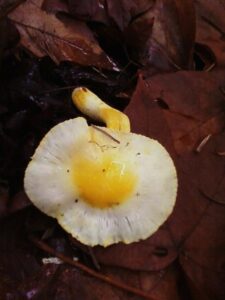


Mushrooms can appear on forest soil, fallen logs, living trees, lawns, mulch, grasslands, compost, and animal-rich ground. Cultivated mushrooms also grow indoors on prepared compost, straw, sawdust, or hardwood logs.
The visible mushroom is only the fruiting structure. Most of the fungus exists as mycelium, a network of fine threads hidden in wood, soil, leaf litter, or another food source. Asking where do mushrooms grow therefore has two answers: where the mycelium lives and where conditions allow a mushroom to appear.
Mushroom habitat overview
| Habitat | Common ecological group | Examples |
|---|---|---|
| Fallen logs and stumps | Wood decomposers | Oyster, turkey tail, lion’s mane |
| Forest soil near trees | Root partners | Chanterelle, porcini, many boletes |
| Leaf litter and rich soil | Litter decomposers | Many small woodland species |
| Lawns and meadows | Grassland fungi | Puffballs, fairy-ring mushrooms |
| Mulch and wood chips | Wood-chip decomposers | Several garden and urban species |
| Burned ground | Fire-associated fungi | Some morels |
| Farms and grow rooms | Cultivated species | Button, oyster, shiitake, maitake |
Forest floors
Forests support a large variety of fungi because they provide trees, roots, leaves, shade, wood, and moisture. Some fungi break down fallen plant material. Others form partnerships with living tree roots.
The mushroom may appear several feet from the tree that supports it because the underground mycelium spreads through the soil. Tree species, soil chemistry, elevation, rainfall, and forest age all influence what fruits in a particular place.
Chanterelles and many boletes are associated with certain trees rather than random piles of dead material. This relationship is one reason they are difficult to cultivate like button or oyster mushrooms.
Fallen logs, stumps, and branches
Wood is a major mushroom habitat. Fungi break down cellulose, lignin, and other parts of dead or weakened trees, returning nutrients to the ecosystem.
Oyster mushrooms often fruit from hardwood logs or stumps. Lion’s mane and related species also grow on wood. Bracket fungi may form shelves on trunks, branches, or logs.
The type of wood matters. A mushroom adapted to hardwood may not thrive on conifer wood, and some species prefer a particular tree. The stage of decay also changes which fungi appear.
Never assume that every mushroom on wood is edible. Habitat is one identification clue, not proof.
Grasslands, lawns, and meadows
Open ground can support mushrooms that feed on dead grass, buried roots, rich soil, or other organic material. Fairy rings form when underground mycelium expands outward and produces mushrooms around the growing edge.
Lawns may fruit after irrigation or rain because moisture reaches hidden mycelium. Fertilizer, soil compaction, tree roots, pet waste, and buried wood can also affect what appears.
Do not eat a lawn mushroom based only on location. Lawns may contain many species, and pesticides or other contaminants can also be present.
Mulch, gardens, and urban spaces
Wood chips, bark mulch, raised beds, old tree roots, and compost create food for fungi. Mushrooms in a flower bed often indicate that organic material is decomposing.
Indoor potted plants can also produce small mushrooms when the potting mix stays moist. Removing the visible cap does not remove the underground mycelium. Adjusting watering and removing decaying material may reduce repeated fruiting.
Urban mushrooms can grow beside sidewalks, in parks, around street trees, and on construction wood. Their ability to grow in a city does not confirm that they are safe to handle as food.
What makes mushrooms appear?
Mycelium may live in a location for months or years without producing visible mushrooms. Fruiting is influenced by:
- Rainfall and soil moisture
- Temperature changes
- Humidity
- Season and day length
- Available food or host roots
- Age and condition of wood
- Disturbance such as fire or soil movement
- Competition with other organisms
A rainy week can trigger a flush, but the timing differs by species. Some mushrooms appear in spring, many in late summer or fall, and others during mild winter weather.
Where mushrooms grow in the United States
The United States contains forests, deserts, grasslands, coastal zones, mountains, and urban habitats, so mushroom diversity is high.
The Pacific Northwest is famous for forest mushrooms associated with conifers and moist woodlands. The Midwest and Northeast have broad hardwood forests, lawns, farms, and seasonal rainfall that support many species. The Southeast has warm, humid conditions and extensive wood decay. Western mountains create short seasonal windows tied to snowmelt and summer rain.
These broad patterns do not replace local knowledge. Elevation, tree community, and recent weather can matter more than state borders.
How cultivated mushrooms grow
Commercial farms do not usually dig mushrooms from forest soil. They cultivate selected fungi on a prepared substrate under controlled conditions.
| Cultivated mushroom | Common growing material |
|---|---|
| White button/cremini/portabella | Prepared compost with a casing layer |
| Oyster | Pasteurized straw or supplemented sawdust |
| Shiitake | Hardwood logs or sawdust blocks |
| Lion’s mane | Supplemented hardwood sawdust |
| Maitake | Hardwood-based blocks |
Growers first establish healthy mycelium in the substrate. They then manage temperature, humidity, fresh air, and light to encourage fruiting. The exact conditions depend on the species and production system.
Button, cremini, and portabella are stages or forms of the cultivated species Agaricus bisporus. Oyster mushrooms belong to Pleurotus species and can grow from several plant-based materials.
Why mushrooms appear overnight
The fungus did not grow from nothing in one night. Mycelium was already present and had stored resources. When conditions became favorable, the fruiting body expanded quickly, often using water to enlarge its cells.
This explains why a lawn may look empty one day and contain several mushrooms after rain. The visible caps are temporary, while the hidden organism may persist.
Safety note for wild mushrooms
Location helps with identification but cannot prove edibility. Dangerous and edible species can grow near each other. Do not eat a wild mushroom based on a habitat description, image, app, or common name.
Use a qualified local expert who can examine the complete specimen, including the base, cap, gills or pores, stem, bruising, odor, spore features, and habitat.
Frequently asked questions
No. Many grow in open lawns, meadows, deserts, or bright forest gaps. They do not use light like green plants, but light can still influence fruiting.
Moisture and humidity can trigger mycelium to produce fruiting bodies when temperature and other conditions are suitable.
No. Fungi reproduce through spores and spread through mycelium. Cultivators use spawn, which is a material colonized by mycelium.
Yes. Farms and home kits grow selected species on prepared substrates under controlled temperature, humidity, and airflow.
Not necessarily. It often means organic material and moisture are present. The meaning depends on the fungus and what it is growing from.