
The blewit mushroom is known for lilac to purple colors when young and a faded tan or brown appearance with age. The wood blewit has long been called Lepista nuda, although some current taxonomic sources place it in Collybia. It often fruits in leaf litter, compost-rich ground, gardens, and woodland edges during cool weather.
Blewits are considered edible when correctly identified and properly cooked, but they have important look-alikes. Purple color alone is never enough. A complete assessment includes the gills, spore print, stem, cap, odor, habitat, and absence or presence of veil remnants.
| Feature | Typical wood blewit clue | Why it matters |
|---|---|---|
| Young color | Lilac, violet, or purple tones | Often fades with age and weather |
| Cap | Smooth, convex when young, flatter later | Shape changes as it matures |
| Gills | Crowded and lilac when fresh | Color alone is not proof |
| Stem | Stout, fibrous, usually without a true ring | Inspect the entire base |
| Spore print | Pale pinkish, buff-pink, or pinkish white | Helps separate rusty-spored look-alikes |
| Odor | Often described as fragrant or perfumed | Subjective supporting clue only |
| Habitat | Leaf litter and rich organic debris | Frequently terrestrial, sometimes in rings |
| Season | Commonly cool fall weather and mild winter periods | Varies by region |
What does a blewit look like?
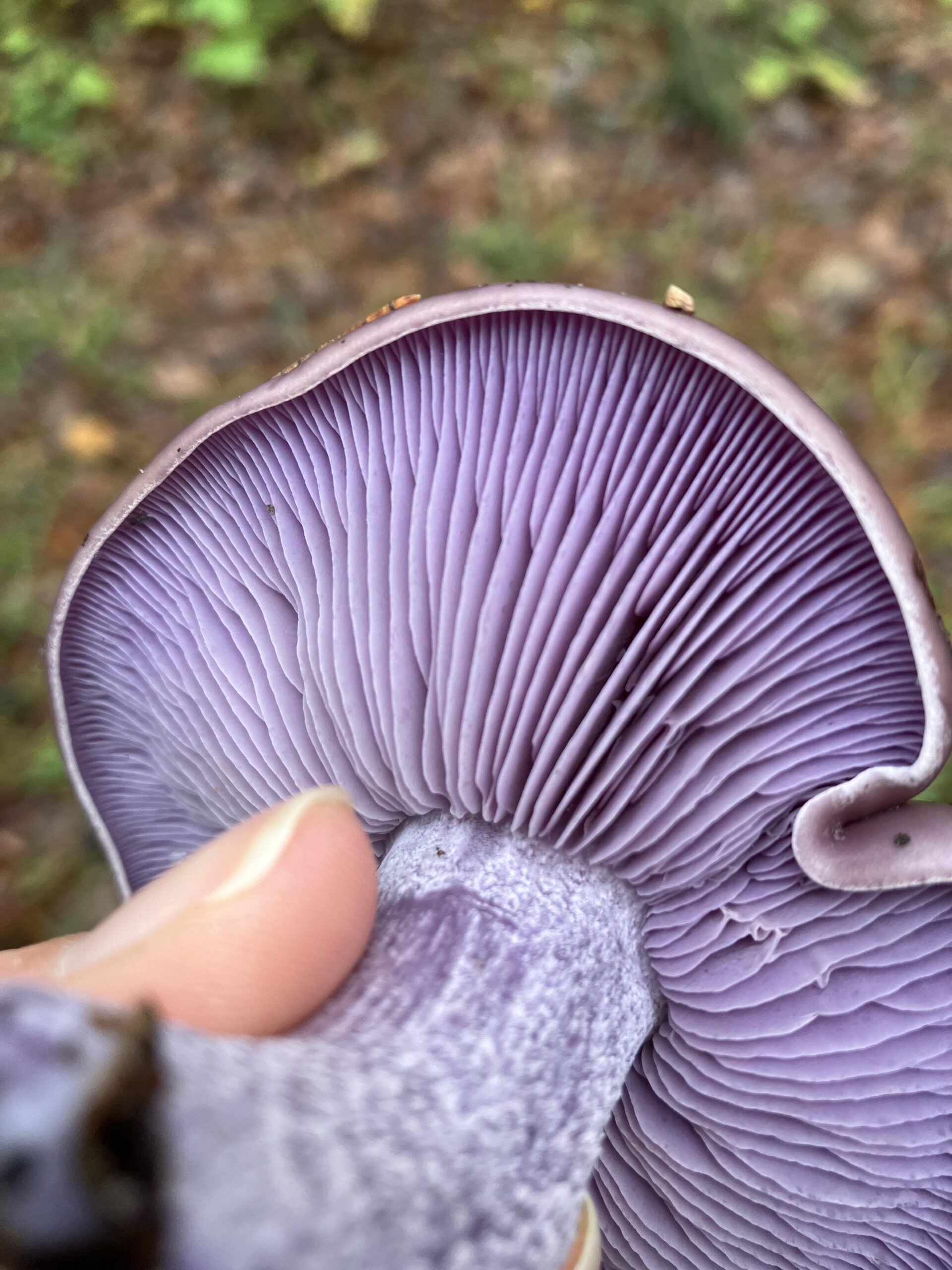
Young specimens can be strikingly purple from cap to stem. With age, sunlight, rain, or dry wind, the cap may fade to buff, tan, gray-brown, or muted lavender. Older mushrooms may retain purple mainly in the gills or upper stem.
The cap is usually smooth rather than scaly. It begins rounded and can become broad with a slightly wavy edge. The closely spaced gills are attached to the stem rather than clearly free. The stem is firm and lacks the prominent skirt-like ring associated with some other genera.
Because color fades, a group may contain young purple buttons and older brown caps that appear unrelated. Study several stages without assuming all nearby mushrooms are identical.
Spore print and look-alikes
Cornell’s mushroom guidance emphasizes the value of a spore print when separating blewits from purple Cortinarius species. Blewit prints are pale or pinkish, while many corts produce rusty-brown spores.
To make a print, remove the stem, place the cap gill-side down across white and dark paper, cover it to reduce drafts, and wait several hours. A print is one data point, not a stand-alone edibility test.
Purple Cortinarius
This large genus contains many confusing species. Rusty spores can color mature gills, and young specimens may show cobweb-like veil fibers called a cortina. The stem base, veil remnants, odor, and ecology matter.
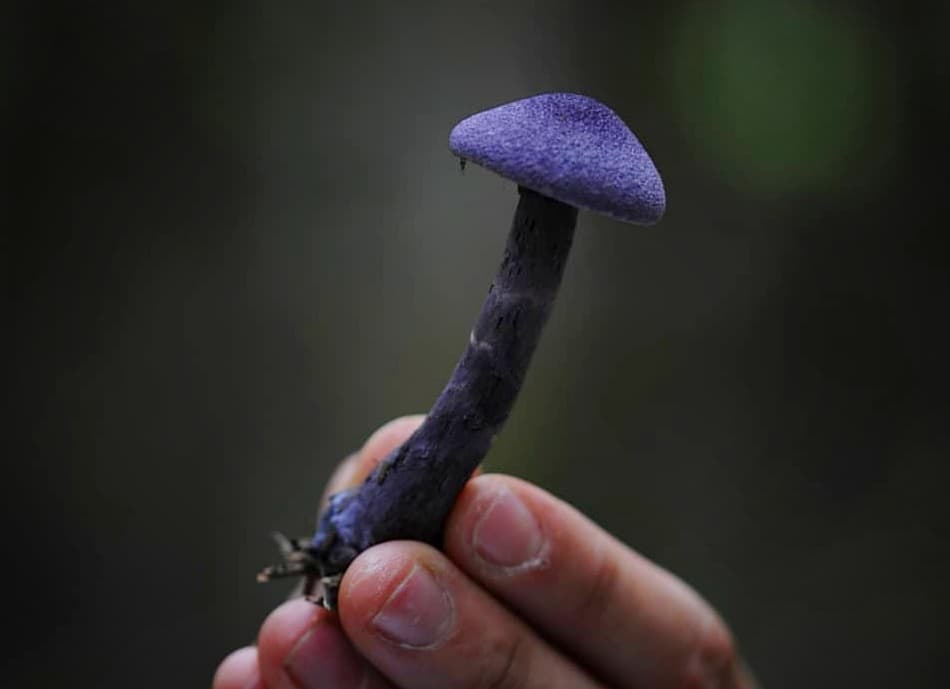
Purple Laccaria
Some Laccaria species are violet, but they often have thicker, more widely spaced gills and a different overall texture. A regional key is still necessary.
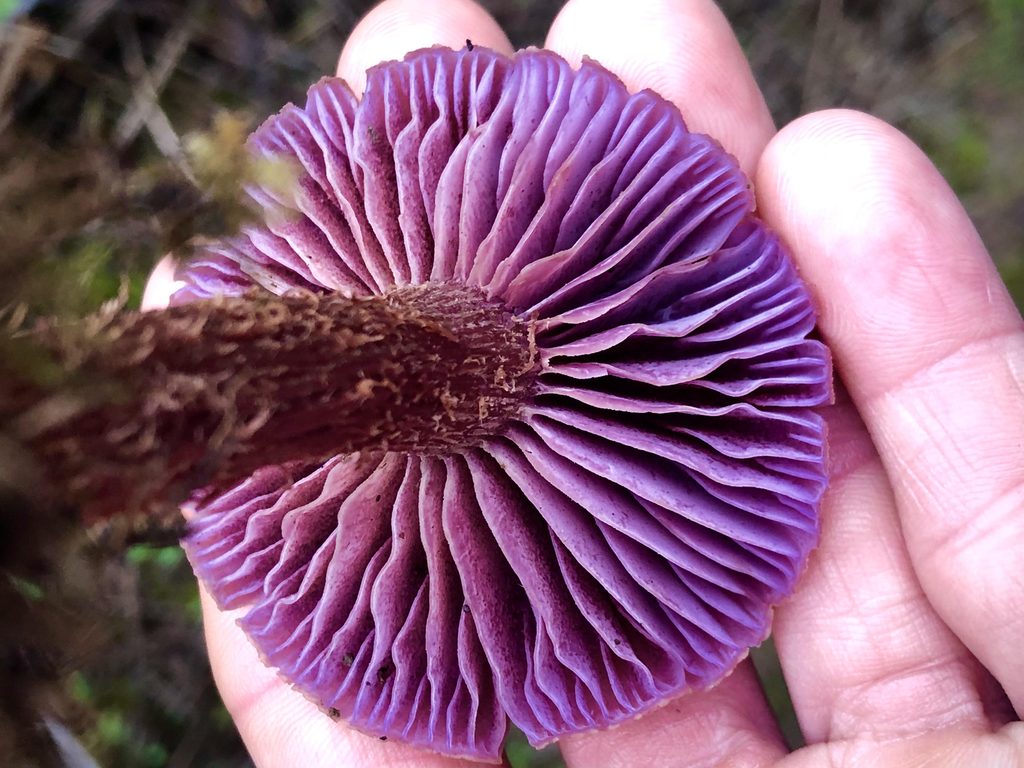
Other faded brown mushrooms
An old blewit may lose most of its purple, making it similar to unrelated tan mushrooms. Never identify a faded cap from color memory alone.

Where a blewit mushroom grows
Wood blewits often grow on decomposing organic matter rather than directly from solid wood. Look in deep leaf litter, garden compost, wood-chip beds, woodland margins, and nutrient-rich soil. They may appear singly, in groups, arcs, or rings.
The name “wood blewit” does not guarantee that the mushroom will be attached to a log. Photograph the habitat, nearby trees, substrate, and the point where the stem meets the ground.
When to find them
Blewits are cool-weather mushrooms. In much of the United States, they are associated with fall and can continue after light frosts or during mild winter periods. Timing shifts with latitude and elevation.
Repeated rain followed by cool weather can encourage fruiting. A site that produces them may do so again, but annual timing and abundance vary.
How to document a possible blewit
- Photograph the undisturbed group and habitat.
- Collect the entire specimen, including the stem base.
- Photograph the cap, gills, stem, and any color changes.
- Note the substrate and nearby tree species.
- Smell without tasting and record the odor in your own words.
- Make a spore print from a mature cap.
- Compare with a current regional key.
- Obtain confirmation from an experienced local identifier.
Apps and image searches may suggest names, but they do not replace hands-on verification of features hidden from a photograph.
Cleaning confirmed edible blewits
Blewits growing in leaf litter can trap soil around the stem base. Trim dirty material and brush the cap and gills carefully. A quick rinse may be used if followed by thorough drying.
Inspect for insects, soft decay, or mold. Keep only young, firm specimens. Do not mix uncertain mushrooms into the same basket or kitchen container as confirmed food.
How to cook a blewit mushroom
Cook confirmed blewits thoroughly. Raw wild mushrooms are not appropriate. Start with a small portion the first time, because individual tolerances vary even with edible species.
Simple sauté
Slice cleaned caps and tender stems. Cook them in a wide skillet with oil until released moisture evaporates. Add butter, shallot, salt, and thyme, then continue until lightly browned.
Cream sauce
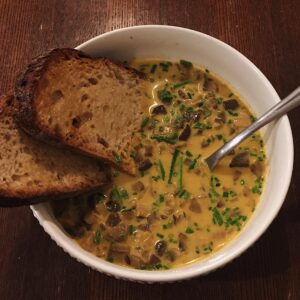
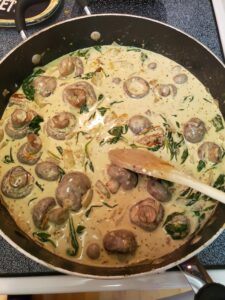
Brown the mushrooms first. Add shallot, a small amount of broth, and cream. Simmer until the sauce lightly coats a spoon, then serve over toast, pasta, or polenta.
Roasted blewits
Toss medium pieces with oil and roast on a roomy pan at 425°F until tender and browned. Finish with lemon and parsley.
Their aroma and texture can be lost in an overly complicated dish, so simple seasonings are a good first preparation.
Storage
Refrigerate clean, unwashed specimens in a breathable paper bag and cook them soon. Wild mushrooms can age faster than sturdy cultivated buttons, especially after warm transport.
For longer storage, only preserve confidently identified, sound mushrooms. Follow a research-based drying or freezing method. Label the package with species, collection date, location, and preservation date.
A careful first-cooking checklist
Before the pan is heated, compare every specimen in the batch. Set aside anything with a different stem, gill attachment, cap texture, or spore deposit. Reconfirm the pale pinkish print and absence of rusty spores associated with common Cortinarius confusion.
Cook the mushrooms by themselves rather than mixing them into a large casserole. Keep the seasoning simple, eat a small portion, and save an uncooked labeled example in the refrigerator. Do not serve a new wild mushroom to several people at once.
If a local expert identifies only the genus or says “likely blewit,” that is not the same as a confirmed food identification. Ask what features ruled out regional look-alikes.
Frequently asked questions
No. Multiple unrelated mushrooms are purple, including look-alikes that require different identification features.
It is generally pale pinkish, buff-pink, or pinkish white—not rusty brown.
They commonly fruit from leaf litter and rich organic material rather than directly from solid logs.
Yes, especially in compost-rich soil, old leaf litter, and wood chips. Yard habitat does not establish edibility.
No. Confirmed specimens should be cooked thoroughly, and first-time users should try only a small amount.