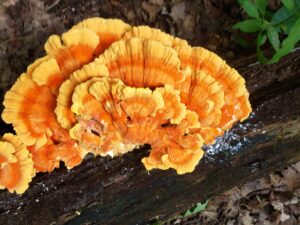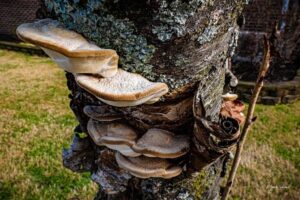

Blue colored mushrooms are uncommon enough to seem unreal, but several fungi develop indigo, sky-blue, blue-gray, or turquoise tones. Examples include the indigo milkcap (Lactarius indigo), New Zealand’s blue pinkgill (Entoloma hochstetteri), the pixie’s parasol (Mycena interrupta), and cultivated blue oyster mushrooms.
Blue color does not create one edible category. Some blue fungi are eaten, others are too small or poorly known, and some belong to groups containing dangerous species. Identification must begin with structure and geography, not color alone.
Blue colored mushrooms comparison
| Mushroom | Blue feature | Native or common region | Food status |
|---|---|---|---|
| Indigo milkcap | Blue cap, gills, flesh, and latex | Eastern North America, Mexico, parts of Asia | Reported edible after expert confirmation |
| Blue pinkgill | Bright blue fruiting body, pink spores | New Zealand | Not a U.S. food mushroom |
| Pixie’s parasol | Small vivid blue cap | Australia, New Zealand, nearby regions | Not a practical food species |
| Blue oyster | Blue-gray young cultivated caps | Grown commercially | Cultivated edible mushroom |
| Bluish Mycena species | Blue cap, edge, or stem base | Several regions | Tiny and difficult; not beginner food |
| Blue-staining bolete | Flesh turns blue after damage | Many bolete groups | Staining alone does not determine edibility |
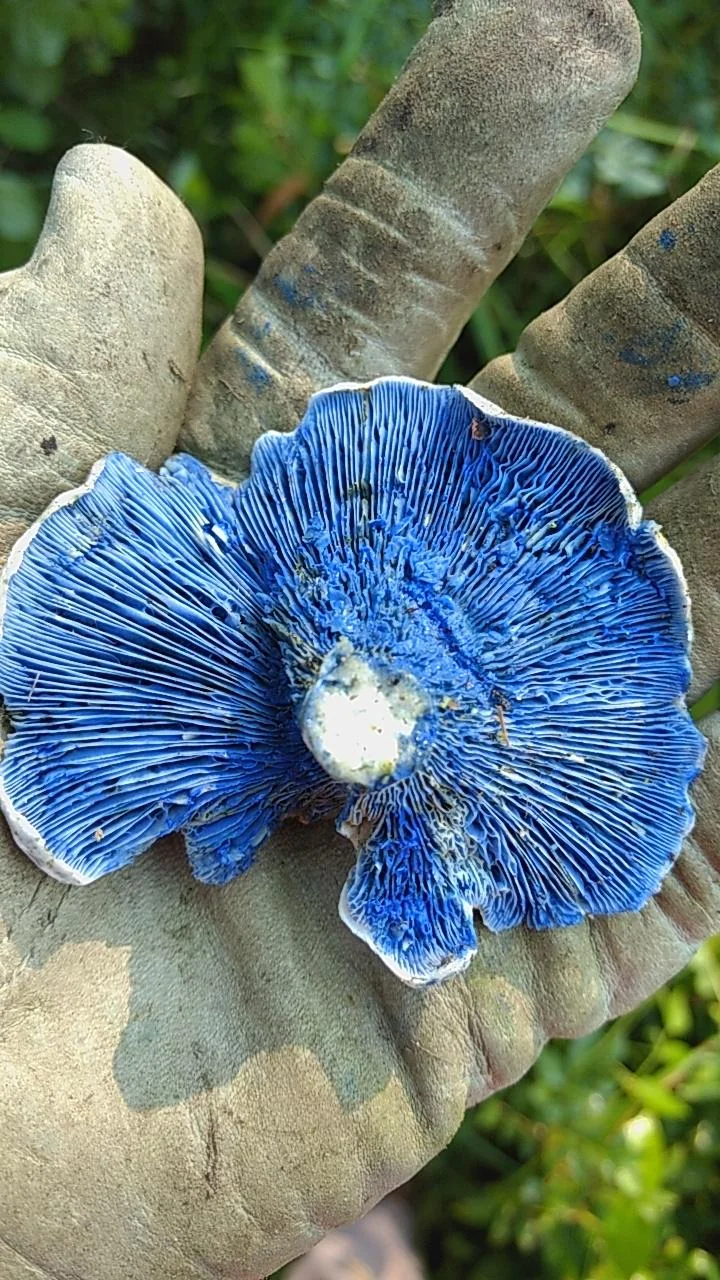
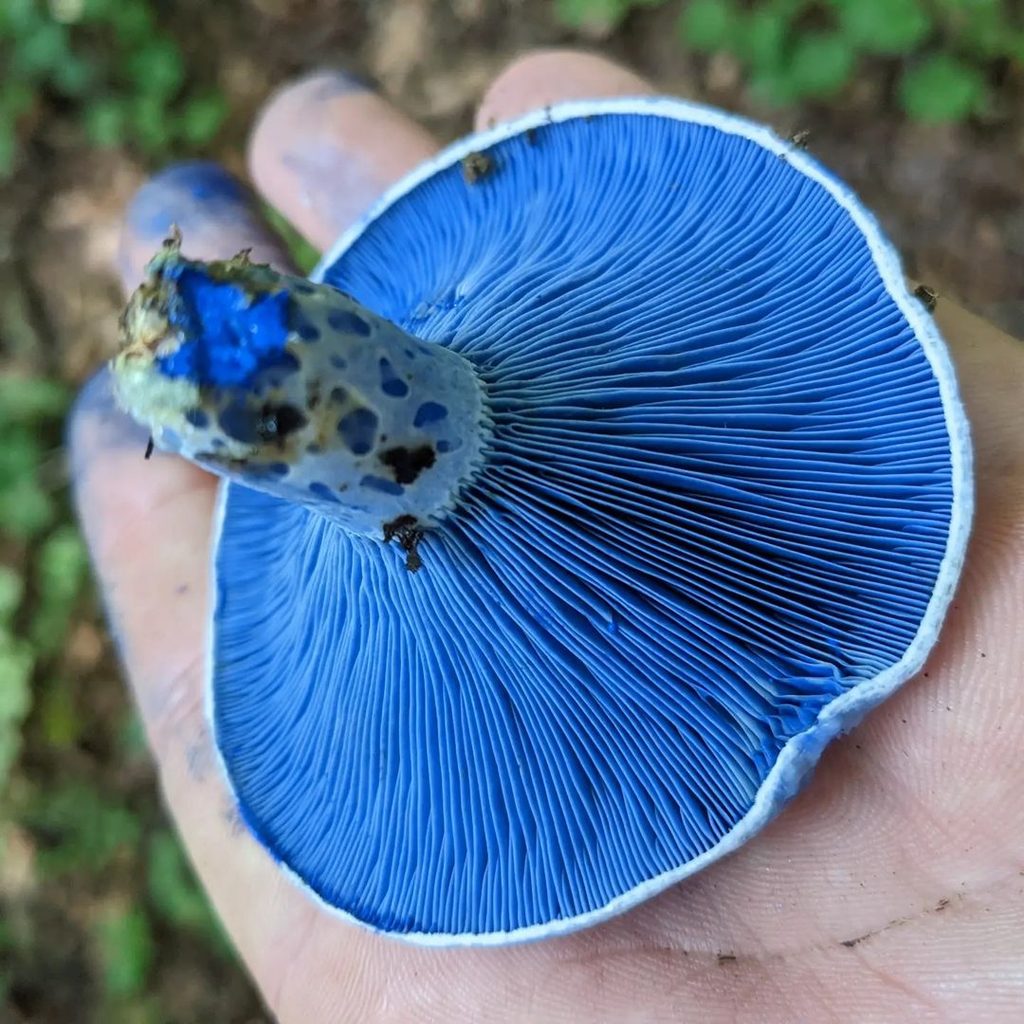
Indigo milkcap
The indigo milkcap is one of North America’s best-known naturally blue mushrooms. Fresh caps can be deep indigo with lighter concentric zones. When the gills or flesh are cut, they release blue latex that gradually shifts toward green.
It grows on soil in association with trees. Missouri Department of Conservation describes bluish gills and blue sap as key features. A full identification also uses brittle flesh, cap form, latex behavior, habitat, spores, and regional look-alikes.
Color fades with age, weather, and handling. Old specimens may appear gray-green rather than brilliant blue.
Blue pinkgill
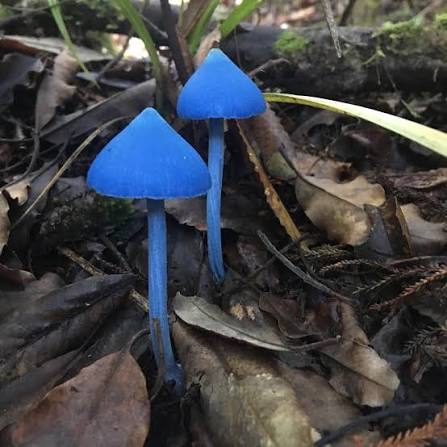
Entoloma hochstetteri is a famous sky-blue mushroom native to New Zealand. The name “pinkgill” refers to the pinkish spore deposit associated with Entoloma, not necessarily bright pink gills in every photo.
Finding a blue mushroom in the United States does not make it this species. Geographic range is a core identification feature, and online images often circulate without location context.
Pixie’s parasol
Mycena interrupta forms tiny bright blue caps on wood in parts of the Southern Hemisphere. The cap can fade toward greenish or yellowish tones. It is visually striking but small and not a practical culinary mushroom.
Research on bluish Mycena shows that multiple species can display blue on the cap, margin, or stem base. Microscopy and taxonomy may be needed to separate them.
Blue oyster mushrooms
Blue oysters are cultivated Pleurotus mushrooms. Young caps may be slate blue or steel blue, then fade to gray as they expand. Cooking also reduces the blue tone.
They grow in shelf-like clusters and are prepared like other oysters: tear into medium pieces, sear in one layer, and add garlic or herbs near the end. Buy them from a grower or food retailer when you want a reliable edible blue-gray mushroom.
Blue staining versus blue pigment
A mushroom can be blue from stable pigments, or it can turn blue after bruising because compounds react with air. Several boletes show dramatic blue staining when cut. The original cap may be brown, yellow, or red.
Blue staining is not a universal poison test. Some edible boletes stain blue, and other problematic species may or may not. Identification requires pores, stem pattern, cap, taste only when a technical expert permits it, host tree, geography, and spores.
Why blue colored mushrooms can change color
Color can shift due to:
- Age and spore maturity
- Sunlight and drying
- Rain and surface moisture
- Bruising or cutting
- Oxidation of latex or flesh
- Camera white balance and filters
- Refrigeration and cooking
Photograph the fresh mushroom in natural light. Record the color change immediately after cutting and again after several minutes.
How to document blue colored mushrooms
- Photograph the undisturbed habitat.
- Record geographic location and nearby trees.
- Show the cap top and underside.
- Collect the complete stem base when legal and appropriate.
- Cut one specimen vertically.
- Note latex, bruising, staining, and timing.
- Make a spore print from a mature cap.
- Keep it separate from food mushrooms.
- Consult a current regional key or qualified expert.
Do not edit the photograph’s saturation before requesting identification.
Can blue mushrooms be eaten?
Some can. Confirmed Lactarius indigo is eaten in parts of its range, and cultivated blue oysters are ordinary food mushrooms. That does not make an unknown blue species edible.
Small blue Mycena and Entoloma species should not be treated as food from a visual comparison. Group-level names, color, and internet popularity do not replace species identification.
Blue mushrooms in lawns or mulch
Blue-green staining on a small lawn mushroom may result from bruising, pigments, age, or even surface mold. Photograph it, keep children and pets away, and remove unknown mushrooms if ingestion is possible.
Mushrooms in mulch usually feed on organic matter and may appear after rain. Their presence does not indicate that the mulch itself is poisonous, but the fruiting bodies remain unknown until identified.
Blue does not always mean the mushroom is blue
Some photographs show blue because of cool shade, camera processing, or reflected sky. Gray, violet, and green surfaces can become bright cyan after automatic phone editing. Place a neutral white or gray object beside the specimen and take another photo in indirect daylight.
A blue stain may also be localized. Record whether the cap was blue before contact, whether only the cut flesh changed, and how long the reaction took. “Blue cap,” “blue latex,” and “blue bruising” describe three different clues.
Pigments and chemical reactions
Fungal color comes from different compounds rather than one universal blue pigment. Research on Lactarius indigo connects its color with azulene-related compounds. In bruising boletes, blue can appear when compounds in damaged tissue oxidize.
These chemical differences explain why one mushroom stays indigo, another turns green, and a third stains blue only where cut. They also explain why color reaction cannot be converted into a simple safety rule.
Teaching children about unusual colors
Blue mushrooms are excellent subjects for photography and nature study. Teach children to look without tasting or collecting. Use a ruler in the image, draw the underside, and note the tree or log.
If unknown mushrooms appear in a play area, remove them before young children or pets can eat them. Keep one complete sample only when professional identification is needed.
Buying cultivated blue oysters
Look for a farm or retailer that labels the mushroom as an oyster and provides a harvest or packing date. Choose dry clusters with unbroken margins. Cook them soon, because the attractive young color fades naturally as the cap expands.
Frequently asked questions
Yes. Some contain blue pigments, while others turn blue through chemical reactions after damage.
The indigo milkcap, Lactarius indigo, releases blue latex when its tissue is damaged.
Usually not strongly. Their young blue-gray caps fade with maturity and heat.
No. It is one identification reaction, not a universal edibility test.
No. Structure, spore print, habitat, range, and expert confirmation are necessary.