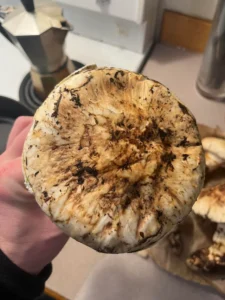
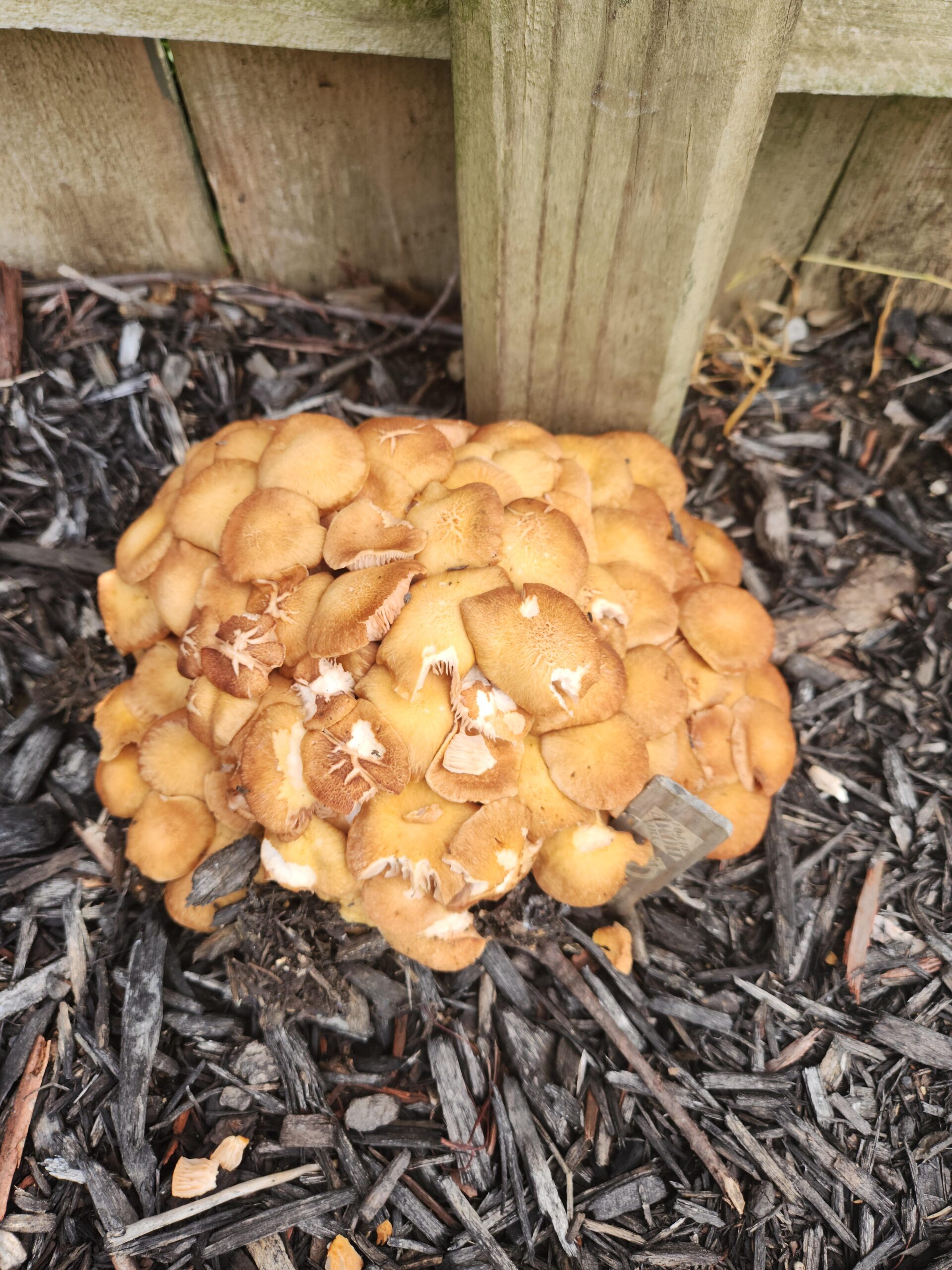

Cluster mushrooms are multiple fruiting bodies growing close together, often from a shared base, log, stump, root, or patch of buried organic matter. Clustering describes a growth pattern, not a species. Oyster mushrooms, honey mushrooms, jack-o’-lanterns, sulfur tufts, enoki relatives, and many small lawn fungi can all appear in groups.
The growth pattern provides clues about the hidden food source. A cluster in open grass may be connected to a buried stump or root. A group at the base of a living tree can justify attention to root or wood condition.
| Pattern | Description | Possible source |
|---|---|---|
| Caespitose | Many stems packed from one point | Stump, root, or buried wood |
| Overlapping shelves | Fan-shaped caps layered on wood | Log, trunk, or branch |
| Troop | Many separate mushrooms in one area | Widespread mycelium in soil or litter |
| Arc or fairy ring | Curved or circular line | Outward-growing underground mycelium |
| Rosette | Leaf-like or shelf-like lobes from a central base | Tree roots or buried wood |
These terms describe form and do not establish edibility.
Why cluster mushrooms grow together
A fungus may have abundant food concentrated in one piece of wood. Multiple mushrooms then emerge from cracks or from a shared underground point. Humidity and temperature can trigger many fruiting bodies at once.
Some clusters appear annually because the mycelium remains in the stump or roots. Removing the caps does not remove the underlying fungus. In mulch beds, clusters may continue until the buried woody material is decomposed.
Clusters on dead wood
Dead logs and stumps naturally support decomposer fungi. Oyster-like shelves may overlap along the side of a log. Small brown or yellow mushrooms can form dense bouquets from cracks.
Record whether the wood is hardwood or conifer if possible, its state of decay, and how the mushrooms attach. Turn one cap over to document gills, pores, or another fertile surface.
Clusters at the base of living trees
Honey mushroom groups can fruit around trunks, stumps, or buried roots. Other decay fungi also form rosettes or shelves near the root flare. The presence of mushrooms does not by itself predict immediate tree failure, but it can indicate a biological process worth assessing.
Look for canopy dieback, cavities, cracks, loose bark, root damage, soil heaving, or a recent lean. If a large tree could hit a structure, road, or gathering area, request an on-site assessment from a qualified arborist.
Clusters in lawns
Lawn mushrooms often feed on old roots, thatch, buried construction wood, or other organic matter. A cluster far from a visible tree may still follow a root from a removed stump.
Most fruiting is temporary. Improving drainage, reducing excess irrigation, removing buried wood when practical, and managing thatch can reduce repeated growth. Fungicide treatment is rarely a simple solution for mushrooms produced by buried organic material.
Familiar groups of cluster mushrooms
Oyster mushrooms
Oysters typically form fan-shaped, overlapping caps on wood. Their gills run down toward a short off-center attachment. Several species and look-alikes exist.
Honey mushrooms
These can form large tan or honey-colored groups at tree bases. Some species have a ring on the stem; ringless honey mushrooms do not. Identification within the group is more complex than the common name suggests.
Jack-o’-lantern mushrooms
Orange Omphalotus mushrooms often appear in dense clusters from wood or buried roots. They have true gills and are a notable chanterelle look-alike.
Sulfur tufts
Small yellow to greenish mushrooms can crowd together on decaying wood. They are not a beginner food mushroom and can resemble other clustered species.
Enoki relatives
Wild Flammulina mushrooms may cluster on wood during cool weather. They look different from long, pale cultivated enoki because outdoor light and airflow change their form. Look-alikes make expert confirmation necessary.
How to document a cluster
- Photograph the entire cluster before touching it.
- Include the tree, log, lawn, or mulch bed in a wider image.
- Photograph the cap tops and edges.
- Show the underside clearly.
- Remove one complete specimen with the stem base.
- Note whether stems fuse together.
- Cut one vertically to show internal structure.
- Record odor, bruising, spore-print color, and date.
Do not assume every mushroom in the frame is the same species. Separate fruitings can overlap on old wood.
Are clustered mushrooms edible?
The arrangement cannot answer that question. Both edible and harmful mushrooms grow in clusters. Even within a commonly eaten group, species, condition, substrate, and individual sensitivity matter.
Never eat a cluster because it resembles one picture. A dense group can hide stem bases and gill attachment, so separate representative specimens and inspect them fully.
What to do around children and pets
Remove unknown lawn mushrooms promptly when curious children or pets use the area. Wear ordinary garden gloves if desired, place the mushrooms in a bag, and dispose of them where they cannot be retrieved.
Touching most mushrooms is not the same as eating them, but wash hands after handling unknown specimens and before food preparation. If ingestion may have occurred, save an intact sample and seek immediate professional guidance.
Can you stop clusters from returning?
Temporary caps can be mowed or picked, but recurrence continues while the underground food source and suitable moisture remain. Remove old stumps and large buried wood where practical, correct irrigation problems, and improve airflow and drainage.
Do not excavate major roots around a living tree without professional advice. Root cutting can harm stability and health.
Make a site map for recurring clusters
Mark the fruiting point on a simple yard sketch and take one wide photograph from the same direction. Record the date, rainfall, nearby tree, stump history, and approximate cluster size. Repeated records can show whether mushrooms follow an old root line or expand through a mulch bed.
For a living tree, note changes in canopy density, cracks, cavities, soil lifting, or new lean. The map does not diagnose risk, but it gives an arborist useful history.
Cleaning up without spreading fragments
Pick or scoop the cluster before mowing if you want to reduce scattered pieces. Place it in a bag and remove it from areas accessible to children and pets. Wash the tool and hands afterward.
Do not compost an unknown cluster where curious animals can reach it. If identification is desired, retain one complete specimen separately with the base and substrate attached.
Clusters in indoor plant pots
Small mushrooms in potting mix usually reflect moist organic material. Reduce unnecessary watering, improve drainage and airflow, and remove caps. Do not let children or pets eat them. Replacing all soil is rarely necessary unless the plant also has a root or drainage problem.
Frequently asked questions
It often indicates concentrated organic material such as a stump, log, root, or mulch beneath the fruiting point.
They may be, but several groups fruit in the same location. Full identification is necessary.
The mycelium was already present. Moisture and temperature triggered rapid expansion of visible fruiting bodies.
No. Mowing removes the temporary mushrooms but not the mycelium in soil or wood.
No, but jack-o’-lantern is an important possibility. Color and clustering alone do not confirm it.